A guide to routing in Next.js (App Router) covering Catch-All Segments, Dynamic Routes, Nested Routes, and more.
 Click to zoom
Understanding the src/app Directory
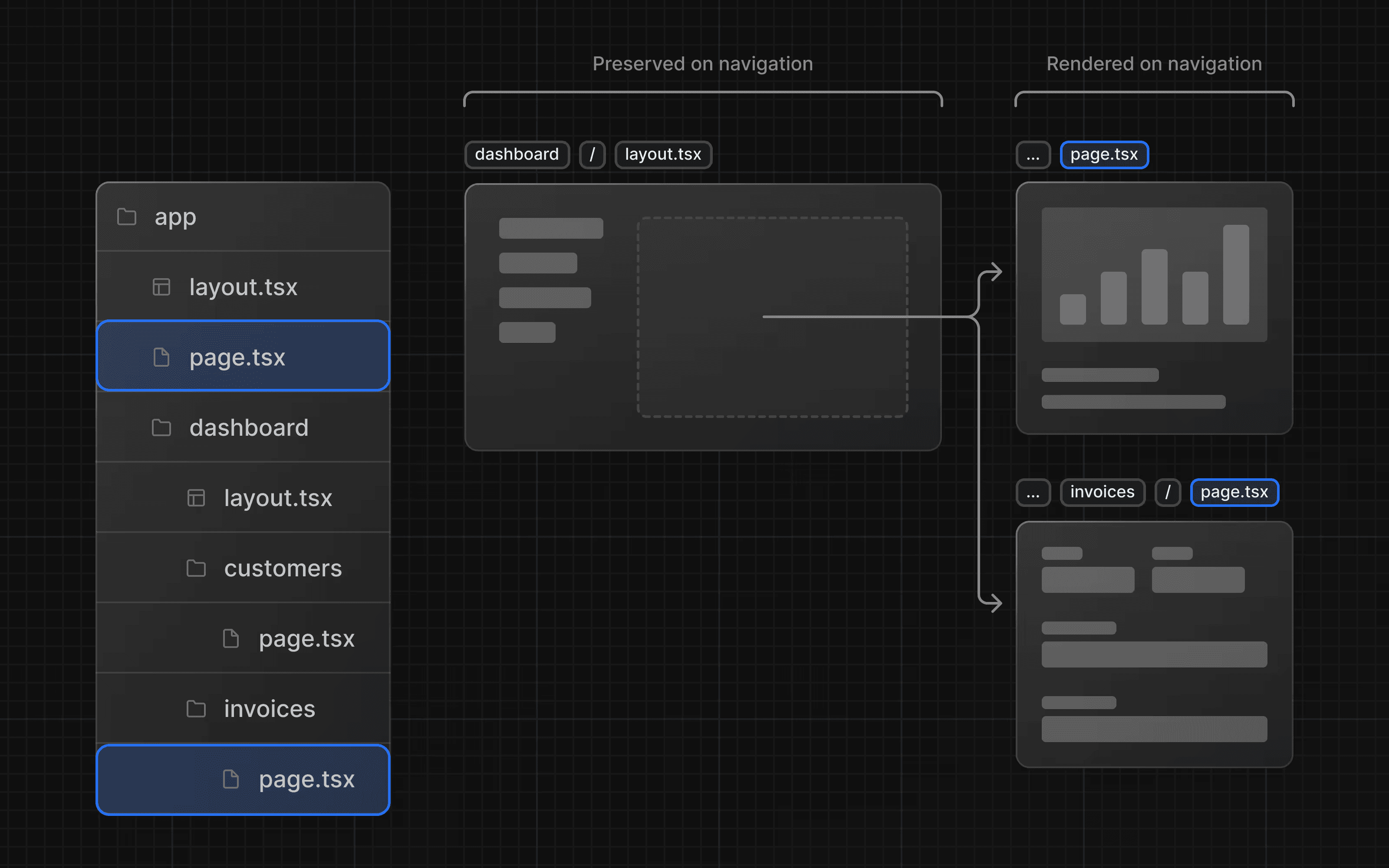
In Next.js (when using the App Router), the src/app directory serves as the foundation for your application's structure. Key files inside this directory include:
- layout.tsx – Defines the layout for your application, allowing you to persist UI elements across different pages.
- page.tsx – Represents the content of a particular route.
Scenario 1: Creating a Homepage
Suppose you want to have a homepage accessible at:
To achieve this, ensure that a page.tsx file exists inside the src/app directory. By default, this file is created when you initialize a Next.js project.
Scenario 2: Creating Additional Pages
Now, let's say you want to create additional pages with different URLs.
Creating an About Page
To create a page accessible at:
Follow these steps:
- Inside the src/app directory, create a new folder named about.
- Inside about, create a page.tsx file.
- Add the following code:
export default function About() {
  return <h1>Hello from About</h1>;
}
Creating a Custom Page (e.g., Ramx Page)
If you want a page accessible at:
Follow the same steps as above:
- Inside src/app, create a folder named ramx.
- Inside ramx, create a page.tsx file.
- Add the following code:
export default function Ramx() {
  return <h1>Hello from Ramx</h1>;
}
Folder Structure for the Pages
After adding these pages, your src/app directory will look like this:
src/app/
   layout.tsx  - Defines layout structure
   page.tsx  - Homepage
   about/
      page.tsx  - About Page
   ramx/
      page.tsx  - Ramx Page
Nested Routes
Scenario 3: Creating Blog Pages
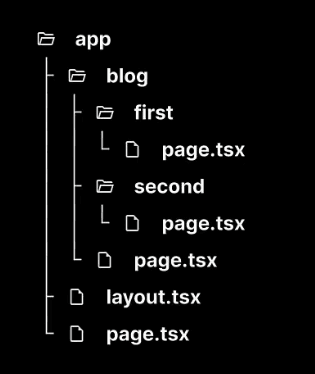
Suppose you want to handle the following routes:
Steps:
- First, create a blog folder inside src/app.
- Inside blog, create a page.tsx file.
This will create the route:
Handling /blog/first and /blog/second
Brute force method (Good for small projects, but not recommended for scalability):
Manually create separate folders:
src/app/blog/first/page.tsx
src/app/blog/second/page.tsx
Each file should contain:
export default function FirstBlog() {
  return <h1>First Blog Post</h1>;
}
export default function SecondBlog() {
  return <h1>Second Blog Post</h1>;
}
 Click to zoom
Dynamic Routing
Scenario 4: Creating a Product Listing Page
Suppose you want to create a product listing page where:
- /products lists all products.
- Individual product pages exist at /products/product-1, /products/product-2, etc.
Each product also has a details page, such as /products/1.
Brute Force Method (Not Scalable)
Manually create:
src/app/products/product-1/page.tsx
src/app/products/product-2/page.tsx
src/app/products/product-3/page.tsx
Using Dynamic Routing (Recommended Method)
Instead of manually creating pages for each product, use dynamic routing.
Steps:
- Create a folder named [productId] inside src/app/products/.
- Inside [productId], create a page.tsx file.
Your folder structure should look like:
src/app/products/
   page.tsx   # Product listing page
   [productId]/
      page.tsx  # Dynamic product page
Code for Dynamic Product Page
export default function ProductPage({
  params,
}: {
  params: { productId: string };
}) {
  return <h1>Product ID: {params.productId}</h1>;
}
Now, if you visit http://localhost:3000/products/100, the params.productId will be 100, and it will render dynamically.
Nested Dynamic Routes
Scenario 5: Category & Product Pages
Let's say you need URLs like:
- http://localhost:3000/categories/electronics
- http://localhost:3000/categories/fashion
- http://localhost:3000/categories/electronics/phones
- http://localhost:3000/categories/fashion/shoes
Steps to Implement:
- Create a categories folder inside src/app.
- Inside categories, create a dynamic [categoryId] folder.
- Inside [categoryId], create a dynamic [subCategoryId] folder.
- Add page.tsx inside both folders.
Folder Structure:
src/app/categories/
   [categoryId]/
      page.tsx  # Category page
      [subCategoryId]/
         page.tsx  # Sub-category page
Code for Category Page:
export default function CategoryPage({
  params,
}: {
  params: { categoryId: string };
}) {
  return <h1>Category: {params.categoryId}</h1>;
}
Code for Sub-Category Page:
export default function SubCategoryPage({
  params,
}: {
  params: { categoryId: string; subCategoryId: string };
}) {
  return (
    <h1>
      {params.subCategoryId} in {params.categoryId}
    </h1>
  );
}
Catch-All Segments
Scenario 6: Handling Unknown Nested Routes
If you need to handle any level of nested paths, use a catch-all segment.
Example URLs:
- http://localhost:3000/docs
- http://localhost:3000/docs/getting-started
- http://localhost:3000/docs/api/reference
How to Implement:
- Inside src/app, create a docs folder.
- Inside docs, create a [...slug] folder (the three dots indicate "catch-all").
- Inside [...slug], create page.tsx.
Folder Structure:
src/app/docs/
   [...slug]/
      page.tsx
Code for Catch-All Route:
export default function DocsPage({ params }: { params: { slug?: string[] } }) {
  return (
    <div>
      <h1>Docs Page</h1>
      <p>Path: {params.slug ? params.slug.join(" / ") : "Home"}</p>
    </div>
  );
}
"You have a right to perform your prescribed duty, but you are not entitled to the fruits of actions."
Design by SahilCodex
© 2026. Built with hands.